If you are leading a team through a significant workplace change, the keys to success are often communication and the ability to bring your team on the change journey.
This article includes five key pillars to help shape your communications, helping you lead others, and create a workplace environment that is conducive to change.
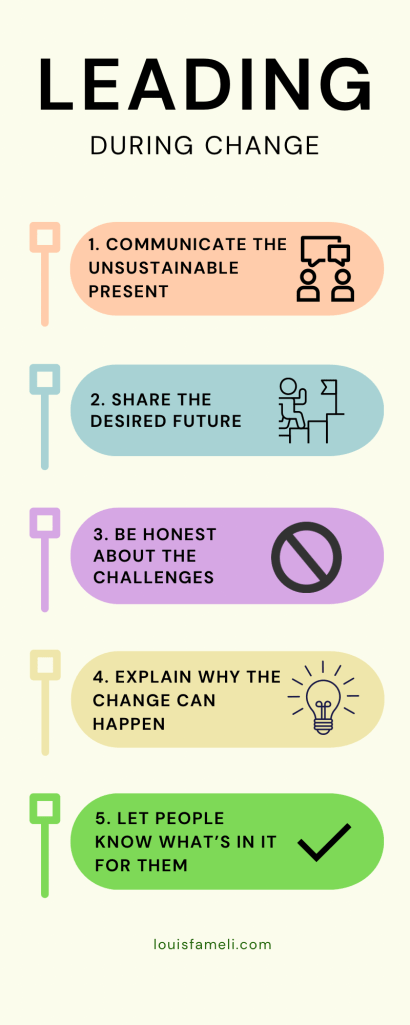
Step one: Communicate the unsustainable present
The first step in making the case for change in the workplace is to help your team understand why change is needed. To do this, you’ll need to explain what would happen if the current state was allowed to continue.
Let’s use the example of adopting a new software package to redesign and streamline your business processes regarding service and product development. In this case, continuing with the current state might mean:
- Cross-functional teams will continue to experience communication delays that impact the customer experience;
- Staff working in this space will not have access to, and training within, systems that are becoming more common across the field;
- The organisation will be unable to provide modern service offerings that customers have come to expect.
Each of those points helps provide clarity for the audience why a change is needed. If possible, make the focus of your message the things you know your team would want to change (i.e., those areas where everyone knows there is room for improvement).
Step two: Share the desired future
The second step in communicating the need for change in the workplace is to move from the unsustainable present you spoke about in step one, toward the future state you are looking to reach by making the change.
Think of this as the next chapter in the story you’re telling your team, with the intention of bringing them along the change journey. In this chapter, the focus is the end result of having made the change.
Keeping with the example of implementing a new software package, here are some examples of what the outcomes of making that change might be:
- Teams have clarity on which decision makers have seen and approved a proposal;
- Customer facing teams such as marketing and customer service have a single source of truth to develop promotional materials, and provide information to external parties;
- Areas across the organisation have a clear picture of the expected timeframes for delivery and implementation of new services or product offerings;
- Higher levels of customer satisfaction and retention, as they benefit from the greater visibility and understanding internal teams would have.
Each of those points illustrates how adopting the system, and changing the underlying processes to embed the system in your workflows can create an improved experience for your team and customers.
Step three: Be honest about the challenges
After you have shared with your team why the change needs to take place, and the desired end result, step three is to share what the road ahead looks like, without glossing over the hard parts.
During these conversations, it’s important to be honest about the realities of what the process will entail, including the potential challenges the team might face.
While you might think putting a positive spin on the process will help your team or organisation, being open about the potential difficulties will give you more credibility and reinforce that your team can trust the information you share.
Continuing with the software implementation example, it would be important to be open about:
- The need to redesign processes in ways that create more transparency and invite feedback from more, and different, stakeholder groups;
- The learning curve that will come from using a new system, and integrating that with the existing systems already in place;
- How the transition period needs to be worked through, to ensure that customers continue to have positive experiences while the change is underway.
The goal with these conversations is to demonstrate to your team that you are aware of the challenges, and are looking to work through them. An added bonus of this approach is that your team are more likely to buy into the change and share their own ideas for solutions.
Step four: Explain why the change can be done
This is technically step 3.5, and you should consider it part of the conversations where challenges are brought up. While it’s important to be honest about the challenges ahead, only talking about those has the potential to deflate your team if those are the only aspects being discussed.
Remember to also discuss the positive aspects, specifically why the change is possible and can be done. Talking about these can help keep morale boosted while the change is underway.
Using the software implementation example, some of the factors you could consider highlighting are:
- The solid foundations of your existing systems, and how they are designed to work alongside the new addition;
- The training plan being developed to help bring various teams along with the change journey and build their skills in the new system;
- Your confidence in the teams involved in delivering the desired state, that they can handle both the transition period and new ways of working.
Hearing these points of view, and how the organisation is ready for this change to take place, will help give your team greater confidence in your capacity to lead the change and ensure it is implemented as planned.
Step five: Let your team know what’s in it for them
The final stage is to share with your team how they will benefit from the change being implemented. Chances are, one of the first things your team will consider when they learn about the change initiative is – “how does this impact me?”
This line of thinking is just simple human nature, any team members who ask questions from this perspective could almost be thanked for asking those types of questions – chances are many others in the area are likely asking themselves the same things.
Consider this an opportunity to not only ease concerns, but also build on the positives you shared in earlier conversations about the unsustainable present and desired end state (steps 1 and 2 in this post).
In the software implementation example we have been using, points to consider might include:
- Less busywork to ensure stakeholders are aware, and aligned in their understanding, of product development activities;
- Fewer emails and other administrative tasks being needed to reach the intended results;
- More chances to work on strategic initiatives, and build new skills that can advance their careers.
Sharing these kinds of points can help build buy-in for the change initiative, and demonstrates to your team that implementing the change can be a win-win scenario for the organisation and the individual team members as well.
Following these steps can help guide your team through the change process, and build an environment where open communication is the norm, and the change initiative has the best chance of success.
Until next time,
Louis


Leave a Comment